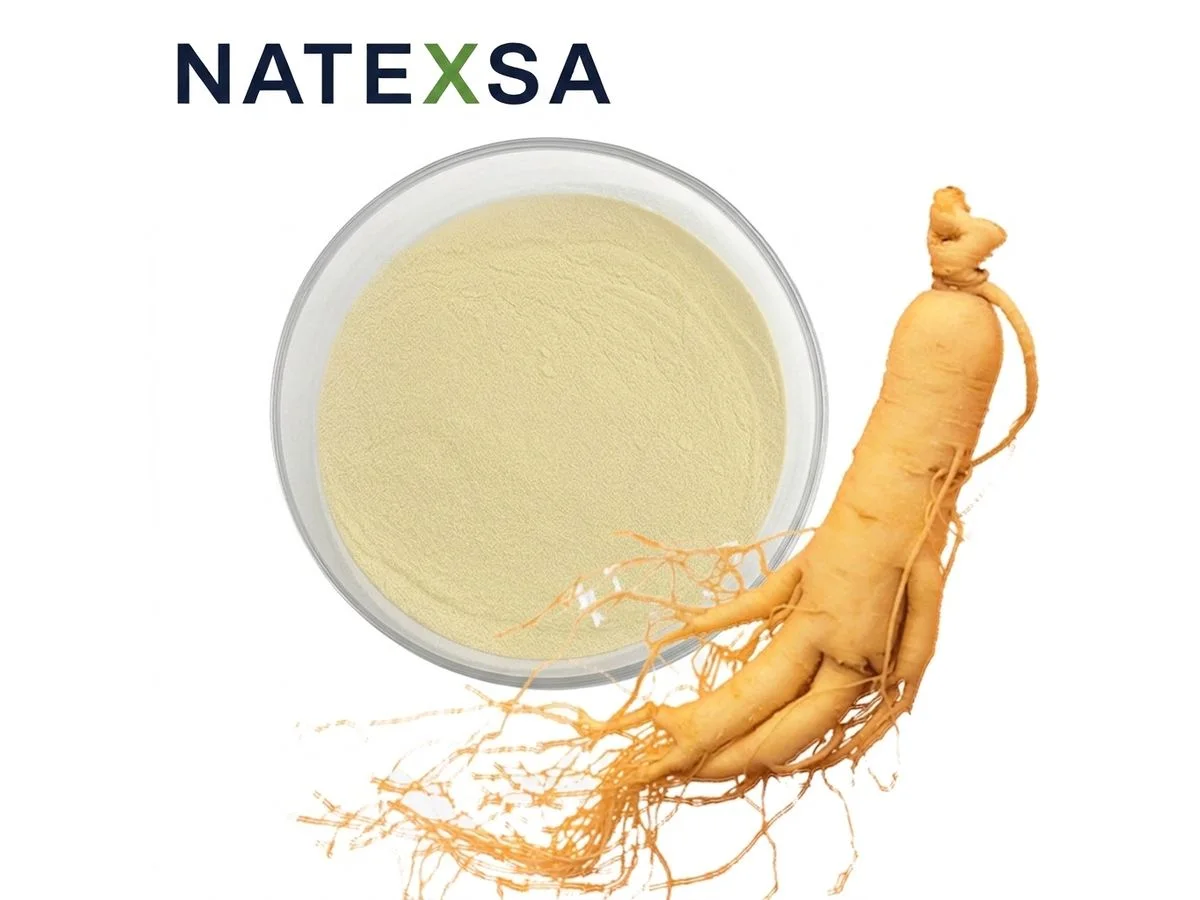
Ginseng Extract is produced from Panax ginseng, whose activity rests on the ginsenosides — a family of triterpene saponins of which more than thirty have been identified — accompanied by polysaccharides and flavonoids. NATEXSA supplies two distinct raw materials: root extract, the classic reference for pharmacopoeial specifications, and stem-and-leaf extract, which naturally carries a higher total ginsenoside content and allows high concentrations at a better cost.
Metabolites
Panax ginseng C.A. Mey.
Part usedRoot; stem and leaf
Ginsenosides, triterpene saponins of the Rg1, Rb1 and Re type.
Metabolites we quantify
- Total ginsenosides10 %–80 %UV
- Rg1≥ 0.30 %HPLC
- Rb1≥ 0.20 %HPLC
Reference doses
Figures published by reference bodies for the preparation named in each row.
| Marker or preparation | Daily dose | Source |
|---|---|---|
| Root dry extract (DER 2–7:1, ethanol 34–40 %) | 200–670 mg/day, in 1–4 doses | EMA · EU herbal monograph, Panax ginseng radix |
These are not a NATEXSA dosage recommendation nor a therapeutic indication: they are cited literature, and the preparation the source refers to does not always match the grade we supply. The regulation of the market where you register the product governs.
Applications
Nutrition & Health
Energy and cognitive-performance formulas, sports nutrition and adaptogenic blends.
Food & Beverage
Functional beverages, shots and instant powders, where its solubility is an advantage.
Personal Care
Skincare positioned around firmness, radiance and protection against environmental stress.
Root or stem and leaf
The root is the traditional reference and the one that appears in most pharmacopoeial monographs; it is the right choice when the specification demands it or when the claim is tied to the classical raw material.
The leaf naturally contains a higher ginsenoside concentration than the root, which makes the stem-and-leaf grade the more efficient route to high-concentration standardisations. Both are legitimate; the choice depends on your regulatory framework and your cost target.
UV vs. HPLC: reading the number
A UV figure quantifies total ginsenosides; an HPLC figure quantifies specific ginsenosides such as Rg1, Rb1 or Rg3. An "80% UV" is not comparable with a "40% HPLC" — the second is far more demanding.
When comparing offers, always confirm the method. NATEXSA states it explicitly on every certificate of analysis to avoid that ambiguity.
Packaging
Aluminium bag
1 – 5 kg
Fibre drum with double inner liner
25 kg
- Shelf life
- Shelf life of 24 months sealed, away from light and moisture.
Specification updated: